The World’s Elite Leaders Want to Replace the USD as the World’s Primary Reserve Currency: This Will Crash the Dollar’s Value and Change Control of World Banking
adUnit = document.getElementById("google-ads-RDE0");
google_ad_client = "ca-pub-1897954795849722";
adUnit = document.getElementById("google-ads-RDE0");
adWidth = adUnit.offsetWidth;
if ( adWidth >= 999999 ) {
/* GETTING THE FIRST IF OUT OF THE WAY */
} else {
google_ad_slot = "0";
adUnit.style.display = "none";
}
 By David Redick
Background on World Banking
As more nations entered international trade, it became convenient for banks to keep currency reserves in their vaults for just a few of the leading nations to fund international exchange deals. Other nations then had to convert to a reserve currency to consummate a deal. International currencies in the past have included the Greek drachma, coined in the fifth century B.C., the Roman denari, the Byzantine solidus and Arab dinar of the Middle Ages, the Venetian ducato and the Florentine florin of the Renaissance, the seventeenth century Dutch guilder and, more recently, the British pound and U.S. dollar. There is always one currency that is treated as Primary because it is deemed safest and easiest to use. This status is conferred by market usage, not a formal agreement. A nation’s status as issuer of a reserve currency varies from strong to terminated, as the ethics, economic and military strength of the issuing nation vary. Figure 1 below shows the various currencies that were Primary Reserve.
Figure 1:
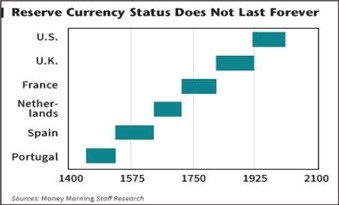 Notice that most last about 100 years and then their nation declines and their currency loses its’ reserve status. Also notice that the USD has been ‘reserve’ since 1925, so has been in reserve status for 96 years. Watch out for decline! This fits with the fact that the USA is a failing empire, as discussed in this link: https://www.activistpost.com/2013/09/empire-usa-is-crashing.html#more.
“The development of the modern concept of a reserve currency took place in the mid nineteenth century (1850), with the introduction of national central banks worldwide and an increasingly integrated global economy.” (more here: https://en.wikipedia.org/wiki/Reserve_currency)
The banks’ control of these international deals led to political issues on rates and types of items in the deals. An example occurred in the 1800s when the Rothschild family of bankers helped finance wars in greater Europe. They would loan to both sides, and the winner had to pay-off the loans for both sides. This worked because the winner could create new fiat money (paper notes, not redeemable for gold) and steal gold from the losers’ vaults. Their family elder, Mayer Amschel Bauer Rothschild, said: “Give me control of a nation’s money and I care not who makes its laws” – 1790.
After WW1, France and England were nearly broke due to war expenses and damage to factories and infrastructure. The USA emerged in 1918 as one of the world’s strongest nations, with a strong currency based on our almost 6,000 tonnes of gold reserves, far ahead of the 1,201 held by France, and 1,046 by England. Thus, the U.S. dollar became the world’s Primary Reserve Currency.
After we spent too much during the Roaring ’20s, we were getting low on gold for redeeming paper notes from Europe, etc. FDR got more gold (for free with paper Fed Notes, ‘made out of thin air’) by issuing Exec. Order 6102 in March, 1933, his first month in office. This Order made it illegal for U.S. citizens to own gold (he called it ‘hoarding’) except for jewelry and rare coins. He paid citizens for their gold at the then official rate of $20.67 of paper Fed Notes per ounce (thus free to the government). He then repriced gold at $35 per ounce for a substantial profit. In 1974, Pres. Ford ended the prohibition to own gold.
googletag.cmd.push(function() { googletag.display('div-gpt-ad-1470694951173-5'); });
(deployads = window.deployads || ).push({});