Inflationomics: The Other New Central Bank Policy To Save The Economy
adUnit = document.getElementById("google-ads-4SNF");
google_ad_client = "ca-pub-1897954795849722";
adUnit = document.getElementById("google-ads-4SNF");
adWidth = adUnit.offsetWidth;
if ( adWidth >= 999999 ) {
/* GETTING THE FIRST IF OUT OF THE WAY */
} else {
google_ad_slot = "0";
adUnit.style.display = "none";
}
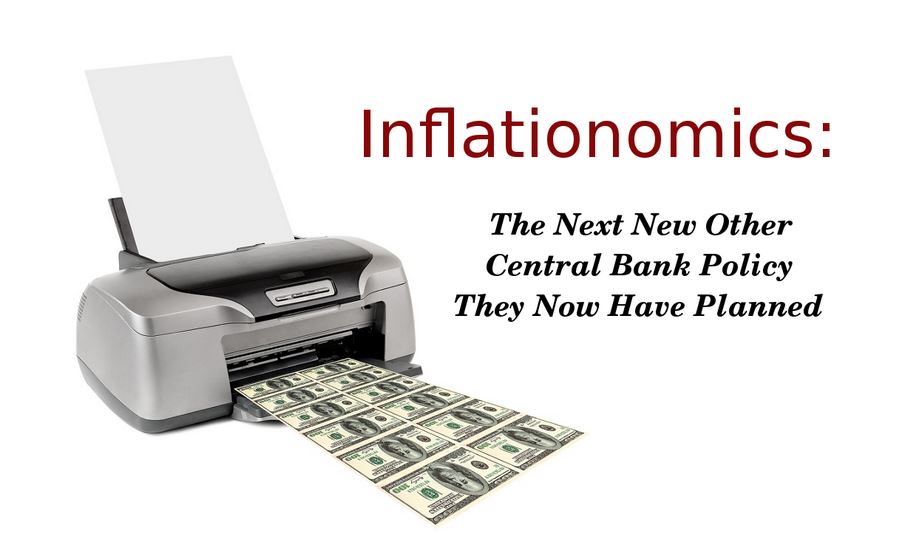
There is an old saying that ignorance is bliss. Indeed that may be true. The uninformed, those who pay no attention to what is going on both economically and politically probably are quite content being oblivious to it all. However, in my case, I cannot help but be perturbed as to the track being taken in terms of current policies adopted by the central banks (and politicians) in the developed nations, which primarily includes Europe, The United States and Japan. And never in my entire adult life has any central bank professed to actually want inflation as they do now. On the contrary, zero inflation and a stable economy was always supposedly the intended preference. But not any more, inflationomics is now the other new goal of these wizards of modern economic alchemy (helicopter money being the other policy currently being touted in a recent rash of sales pitches, the metaphorical raising the flag up the pole to see if it catches wind).
However, we suppose this act of desperation is understandable. Central bankers are frightened to death of deflation and truth be told we are in and have been in since 2008 an economic scenario quite similar to the economic depression of the 1930s. No one in government or the mainstream media wants to come out and blatantly say it, and of course it does not seem that way because a number of social welfare programs put in place after the economic depression some 70 plus years ago has provided a support system eliminating the need for Hoovervilles and the unemployed selling fruit on street corners. But, while politicians are quite adept at oratory ambiguities, the numbers do not lie.
Economics is like gravity: Ignore it and you will be in for some rude surprises – Charles Wheelan
The University of California Berkeley completed a study back in April 2015 whereby they examined social welfare expenditures. What caught our attention was not the annual cost of US$150 Billion for such programs but rather the comment that: Inflation adjusted wage growth from 2003 to 2013 was either flat or negative for the entire bottom 70 percent of the wage distribution. The report goes on to say that about 75 percent of all public support program participants are from working families. In other words, the already existing inflation has eroded the purchasing power of lower wage workers AND public assistance programs are NOW being utilized to supplement that loss. While the bean counters at the US Bureau of Labor Statics continue to espouse an inflation rate of less than one percent, the Shadowstats service pegs US inflation at 8.5% as of July 2016. Quite a difference, would you not say?
googletag.cmd.push(function() { googletag.display('div-gpt-ad-1470694951173-5'); });
(deployads = window.deployads || ).push({});