Hawaii Bill Would Legalize Raw Milk Sales, Important Step To Nullify Federal Prohibition
adUnit = document.getElementById("google-ads-KNkg");
google_ad_client = "ca-pub-1897954795849722";
adUnit = document.getElementById("google-ads-KNkg");
adWidth = adUnit.offsetWidth;
if ( adWidth >= 999999 ) {
/* GETTING THE FIRST IF OUT OF THE WAY */
} else {
google_ad_slot = "0";
adUnit.style.display = "none";
}
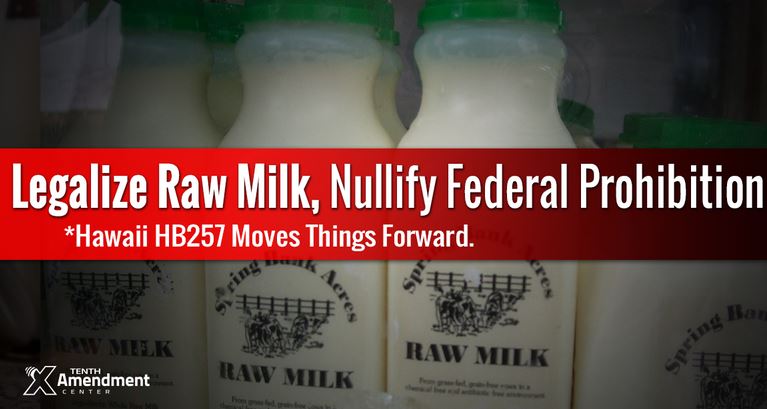
A bill introduced in the Hawaii House would legalize raw milk sales in the state, taking an important step toward nullifying a federal prohibition scheme in effect.
A bipartisan coalition of 13 representatives sponsor House Bill 257 (HB257). The legislation would legalize retail sale of raw milk and raw milk products in Hawaii. It would also allow consumers to obtain raw milk through herd share agreements. The bill includes labeling requirements and prohibits the sale of raw milk more than 120 hours after milking.
Under current law, raw milk sales are completely prohibited in Hawaii.
Impact on Federal Prohibition
FDA officials insist that unpasteurized milk poses a health risk because of its susceptibility to contamination from cow manure, a source of E. coli.
“It is the FDA’s position that raw milk should never be consumed,” agency spokeswoman Tamara N. Ward said in November 2011.
The FDA’s position represents more than a matter of opinion. In 1987, the feds implemented 21 CFR 1240.61(a), providing that, “no person shall cause to be delivered into interstate commerce or shall sell, otherwise distribute, or hold for sale or other distribution after shipment in interstate commerce any milk or milk product in final package form for direct human consumption unless the product has been pasteurized.”
Not only do the feds ban the transportation of raw milk across state lines, they also claim the authority to ban unpasteurized milk within the borders of a state.
googletag.cmd.push(function() { googletag.display('div-gpt-ad-1470694951173-5'); });
(deployads = window.deployads || ).push({});