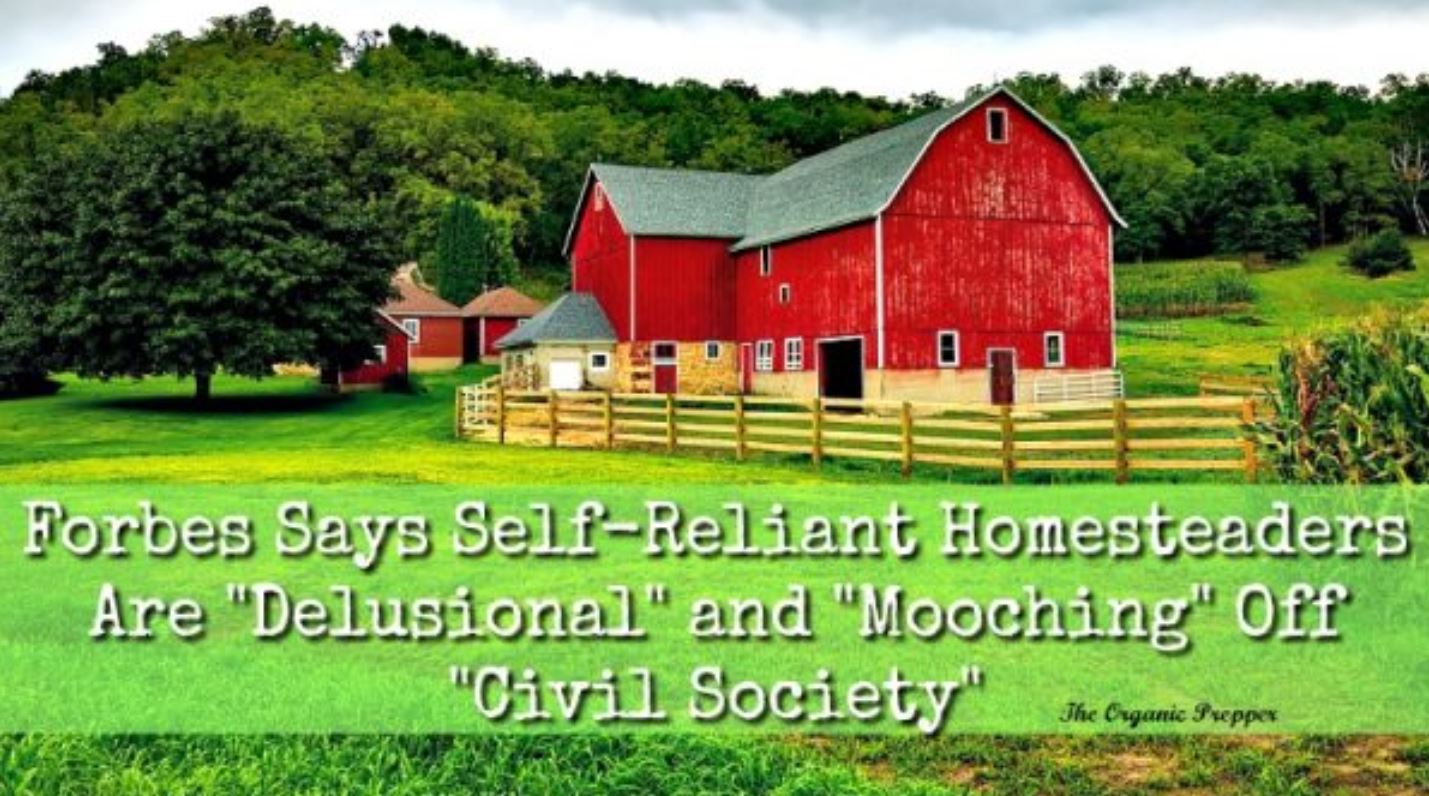
Forbes Says Self-Reliant Homesteaders Are “Delusional” and “Mooching” Off “Civil Society”
adUnit = document.getElementById("google-ads-SJqY");
google_ad_client = "ca-pub-1897954795849722";
adUnit = document.getElementById("google-ads-SJqY");
adWidth = adUnit.offsetWidth;
if ( adWidth >= 999999 ) {
/* GETTING THE FIRST IF OUT OF THE WAY */
} else {
google_ad_slot = "0";
adUnit.style.display = "none";
}
 By Daisy Luther
It’s always interesting reading when someone smug and sanctimonious writes a clueless diatribe about another group of people being smug and sanctimonious. So when I saw that an economist for Moody’s and Forbes had written an op-ed calling self-reliant homesteaders “delusional,” I knew I’d be in for some misinformed hilarity.
The article, entitled, “Dear Homesteaders, Self-Reliance Is a Delusion” was published a couple of days ago on the Forbes website. You’ll be forewarned that the article won’t be deep in the first paragraph, when the author presents his claim to knowledge about self-reliant living comes from the fact that he is “a big fan of shows about doomsday preppers, homesteaders, survivalists, generally people who live off the grid.”
And the well-informed opinion of this arbiter of self-reliance?
…there’s a central delusion in these shows that is never far from my mind when I’m watching these shows: off the grid people are not self-reliant, but instead are mooching off of the civil society, government, and safety net the rest of us contribute to…
The people in these shows often describe a very romantic vision of the lives they have chosen the ethos underlying it. They describe themselves as fully self-reliant, and criticize the rest of society as being dependent and lacking in this self-reliance. It is morally superior, the story goes, to provide for yourself, take care of your own needs, and often, be prepared to survive if society collapses.
First, let me segue a little bit and tell you about the author. According to his bio on Economy.com:
Adam Ozimek is an associate director and senior economist in the West Chester office of Moody’s Analytics. Adam covers state and regional economies, as well U.S. labor markets and demographics. Prior to joining Moody’s Analytics, Adam was Senior Economist and Director of Research for Econsult Solutions, an economics consulting company. He received his Ph.D. in economics from Temple University and his bachelor’s degree in economics from West Chester University.
So, based on this, I’m going to guess that homesteading and off-grid living aren’t his jam. I mean, he might head down to the Westtown Amish Market there in Pennsylvania, but I’d be willing to place money on that being his closest brush with any real, live, self-reliant homesteaders.
His ill-conceived argument seems to be mostly focused on health care. He is baffled about what will happen if a homesteader becomes ill or gets injured.
On Live Free Or Die, a man in his mid sixties named Colbert lives in the Georgia swamps alone….I always wonder what will happen if he slips and falls, and can no longer provide for himself. He’ll likely end up receiving hospital treatment paid for with Medicare, and perhaps end up in an assisted living center paid for by Medicare as well.
Or…
Another example from Live Free or Die is Tony and Amelia, a couple who live on a simple, off-the-grid homestead in North Carolina. When I watch them I wonder what would happen if one became extremely sick, and simple, off-the-grid home medicine couldn’t treat them. Would they say “we’ve chosen our fate, and now we die by it”, or would they seek treatment in a hospital they couldn’t afford which would be covered by the hospital’s charity care or perhaps Medicaid?
One thing that Dr. Ozimek is missing is the fact that most homesteaders are tax-paying citizens. Does he think that living on a homestead exempts one from property taxes? Does he suppose that their vehicles don’t have license plates or that their fuel is purchased without the requisite state gasoline tax? Or that maybe they have some special card that lets them buy things like feed without paying sales tax? Perhaps homesteading equipment like tractors and tools and off-grid appliances are likewise purchased without any gain to “society.”
googletag.cmd.push(function() { googletag.display('div-gpt-ad-1470694951173-5'); });
(deployads = window.deployads || ).push({});