This Graph Says It All — US 2016 Recession Already Here!
adUnit = document.getElementById("google-ads-E1TP");
google_ad_client = "ca-pub-1897954795849722";
adUnit = document.getElementById("google-ads-E1TP");
adWidth = adUnit.offsetWidth;
if ( adWidth >= 999999 ) {
/* GETTING THE FIRST IF OUT OF THE WAY */
} else {
google_ad_slot = "0";
adUnit.style.display = "none";
}
This graph by 720Global shows how spot on my pronouncement of a US 2016 recession is. In spite of the lack of any official declaration by the US government or its economic priesthood, I’ve stated more than once in 2016 that the US is already in recession. Several interesting observations can be made from this graph:
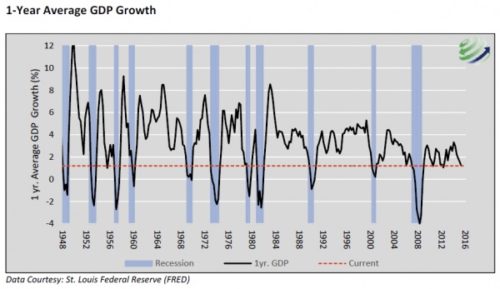
- The red line marks current US GDP (1.2%) as estimated by the US Bureau of Economic Analysis (BEA). At virtually every point in the last seventy years when US GDP hit 1.2%, the US has been solidly in recession (blue areas). In other words, the US was not ABOUT to go in recession at that level of growth, but was IN recession each time … with only three exceptions. Two of those are “exceptions that prove the rule” (i.e., the very reason these exceptions happened prove how significant the underlying rule or belief is):
- Twice during the years since the Great Recession, GDP touched this low, and we did not go officially into recession, but look at why: In both of those instances the US only averted recession because the Federal Reserve immediately kicked in massive doses of quantitative easing. (The Federal Reserve is not going to do any immediate quantitative wheezing to keep us above the line this time because all of its talk has been about raising interest rates. More wheezing would prove the Fed is unable to raise interest rates (as I said last fall would be the case after made its first raise in December. So, the Fed will only apply QE at this point when it sees for certain that its patient is dying, which will be too late.)
- The graph reminds us of something we’re all aware of: Based on the average frequency between recessions, the US is due for a recession in 2016 anyway.
- An even more interesting observation to note is the general long-term decline of US economic growth. Seventy years ago, the US emerged from recession with 12% growth in GDP. For the next thirty years, it would emerge with about 8% growth. For the next twenty years after that, the best the US could hope to see was around 4% growth in GDP; and for the past decade, the highest peaks the US can manage in economic growth have been about 3% growth in GDP.
(adsbygoogle = window.adsbygoogle || ).push({});
In part, the declining growth rate in GDP could be because it is harder to get as large of a percentage increase as GDP gets larger. (In the sense that it is easier to double your speed at ten miles per hour than it is at fifty miles per hour.)
However, I think it also reflects how, as US national debt has piled up, its ability to achieve growth has significantly diminished because of all the ballast it is carrying. The fact that it has taken enormously greater stimulus to achieve these steeply diminishing returns indicates the severe drag created by this ballast.
One could also blame increasing regulations; but there is one very interesting thing you cannot blame … and that is taxes. We consistently achieved much higher rates of growth back in times when income tax (and especially capital gains tax) was much, much higher (both corporate and individual). So, the growth decline certainly can’t be blamed on higher taxes because they aren’t higher.
googletag.cmd.push(function() { googletag.display('div-gpt-ad-1470694951173-5'); });
(deployads = window.deployads || ).push({});